If you are reading this at 2:00 AM, staring at a glowing screen while the rest of your household is asleep, you are not alone. Struggling with sleep is a profoundly isolating experience, yet it is one of the most common health concerns brought to UK GP surgeries.
Understanding whether you are simply going through a temporary rough patch or experiencing a clinical condition is the first step toward reclaiming your rest. This comprehensive guide explores the reality of sleep problems UK residents face, examining the causes, symptoms, and evidence-based treatments that can help you return to restorative sleep.
Understanding Sleep Problems in the UK
According to the NHS, roughly one in three adults in the UK will experience sleep problems at some point in their lives . While an occasional sleepless night is normal and usually linked to a specific stressor, persistent sleep disturbances can severely impact your physical health, mental wellbeing, and quality of life.
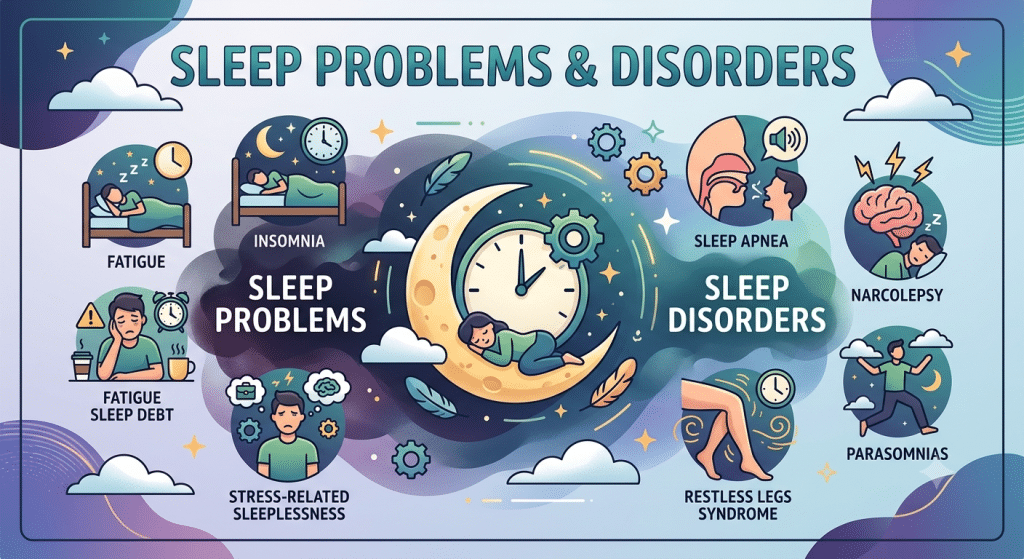
Sleep problems generally fall into two categories:
1. Insomnia: The inability to fall asleep, stay asleep, or wake up too early, despite having the opportunity to sleep.
2. Sleep Disorders: Specific physiological or neurological conditions that disrupt sleep, such as sleep apnoea, restless legs syndrome, or parasomnias (like sleepwalking).
What Are the Insomnia Symptoms?
Insomnia is more than just feeling tired. It is a clinical condition characterized by a cycle of frustration and hyperarousal. Recognising insomnia symptoms is vital for determining whether you need to adjust your lifestyle or seek medical intervention.
Common symptoms include:
Difficulty falling asleep at night (taking longer than 30 minutes to drift off).
Waking up during the night and finding it difficult to go back to sleep.
Waking up earlier than desired in the morning.
Daytime fatigue or sleepiness.
Irritability, depressed mood, or anxiety.
Increased errors or accidents.
Tension headaches or gastrointestinal distress caused by sleep deprivation.
Acute vs. Chronic Insomnia
The NHS distinguishes between short-term (acute) insomnia, which lasts for a few days or weeks, and long-term (chronic) insomnia, which occurs at least three nights a week for three months or more . Chronic insomnia often requires targeted treatment, whereas acute insomnia may resolve once the initial trigger is addressed.
What Are the Main Poor Sleep Causes?
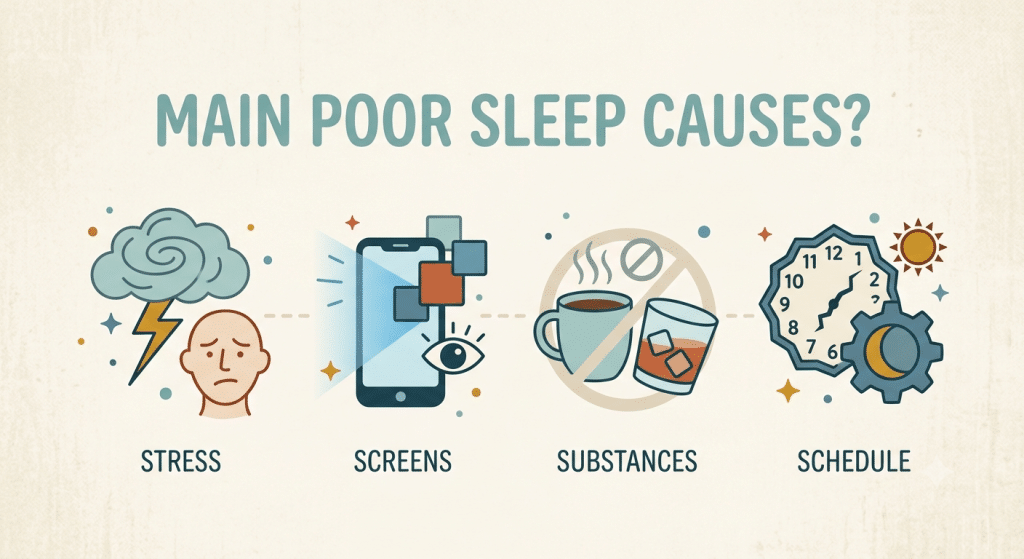
To fix a sleep problem, you must identify the root cause. Poor sleep causes are rarely singular; they are usually a complex mix of psychological, lifestyle, and environmental factors.
Psychological and Lifestyle Factors
Stress and Anxiety: Worries about work, finances, or family can keep your brain in a state of hyperarousal, making it impossible to relax.
Mental Health Conditions: Depression and anxiety disorders are deeply linked to disrupted sleep architecture.
Shift Work: The UK has a significant shift-working population. Working nights or rotating shifts disrupts the circadian rhythm (the body’s internal clock).
Substance Use: Caffeine is a well-known stimulant, but alcohol is a hidden culprit. While alcohol might help you fall asleep faster, it fragments your sleep cycle and reduces the amount of restorative Rapid Eye Movement (REM) sleep .
Underlying Medical Conditions
Sometimes, poor sleep is a symptom of an undiagnosed physical health issue:
Sleep Apnoea: A condition where breathing stops and starts during sleep, causing you to briefly wake up gasping for air.
Restless Legs Syndrome (RLS): An overwhelming urge to move the legs, often accompanied by an uncomfortable crawling sensation.
Chronic Pain: Conditions like arthritis or neuropathy can make it difficult to find a comfortable sleeping position.
Hormonal Changes: Menopause often brings hot flashes and night sweats that severely disrupt sleep.
The Hidden Risks of Chronic Sleep Deprivation
Sleep is not a luxury; it is a biological necessity. During sleep, your body repairs tissues, synthesizes hormones, and consolidates memories.
Chronic sleep deprivation puts you at risk for:
Weakened Immunity: You become more susceptible to common infections like the cold or flu.
Cardiovascular Issues: Long-term poor sleep is associated with an increased risk of high blood pressure, heart disease, and stroke .
Weight Gain: Sleep regulates the hormones that control appetite (leptin and ghrelin). Poor sleep increases cravings for high-calorie foods.
Mental Health Deterioration: There is a bidirectional relationship between poor sleep and mental health; lack of sleep exacerbates mental health issues, which in turn worsens sleep.
How to Sleep Better: Practical Self-Help Strategies
If your sleep problems are mild or acute, implementing behavioural changes is the best first step. Many people searching for how to sleep better are looking for a magic pill, but the reality is that consistency is key.
Mastering Sleep Hygiene
Sleep hygiene refers to the daily habits and practices that are conducive to sleeping well on a regular basis.
Evidence-based sleep hygiene principles include :
Your Bedroom Environment: Your bedroom should be dark, quiet, and cool (around 18°C or 65°F). Consider using blackout curtains and earplugs if you live in a noisy urban area.
The 20-Minute Rule: If you cannot fall asleep after 20 minutes, do not lie there tossing and turning. Get up, go to a dimly lit room, and do something relaxing (like reading a physical book) until you feel sleepy, then return to bed. This prevents your brain from associating your bed with frustration.
Digital Detox: The blue light emitted by smartphones and tablets suppresses the production of melatonin, the hormone that makes you feel sleepy. Avoid screens for at least an hour before bed.
Establish a Routine: Go to bed and wake up at the same time every day, even on weekends. This reinforces your body’s circadian rhythm.
Important Note: While sleep hygiene is an excellent foundation, research shows that for people with chronic insomnia, sleep hygiene alone is rarely enough to cure the condition [6]. This is where medical interventions come in.
Sleep Disorder Treatment: When Self-Help Isn’t Enough
If you have optimized your sleep hygiene and are still struggling, it may be time to explore professional sleep disorder treatment. The medical approach to treating sleep issues has evolved significantly over the last decade.
CBT for Insomnia
The National Institute for Health and Care Excellence (NICE) and the NHS explicitly recommend CBT for insomnia (Cognitive Behavioural Therapy for Insomnia) as the first-line treatment for chronic insomnia
CBT-I is a structured program that helps you identify and replace thoughts and behaviours that cause or worsen sleep problems. Unlike medication, it targets the underlying causes of insomnia.
Key components include:
Sleep Restriction: Temporarily reducing the time spent in bed to match the actual time you spend asleep. This builds sleep drive and makes you fall asleep faster.
Cognitive Restructuring: Challenging anxieties about sleep (e.g., “If I don’t get eight hours, I’ll be fired tomorrow”).
Stimulus Control: Re-training the brain to associate the bed exclusively with sleep and intimacy, not with wakefulness, scrolling, or worrying.
CBT-I can be delivered face-to-face, via group therapy, or through digital NHS-approved apps like Sleepio.
Medical Interventions and Sleep Medications
Historically, doctors prescribed sleeping pills (like benzodiazepines or Z-drugs) much more freely. Today, due to the risks of dependency, daytime drowsiness, and falls (particularly in older adults), NICE guidelines state that these medications should only be prescribed for short periods—usually a maximum of two to four weeks , and strictly after CBT-I has been considered or failed.
If an underlying condition is causing your sleep problems—such as sleep apnoea—your treatment will look entirely different. For sleep apnoea, a continuous positive airway pressure (CPAP) machine is the standard treatment. For RLS, iron supplements or specific dopamine-agonist medications may be prescribed.
When to See a GP About Your Sleep
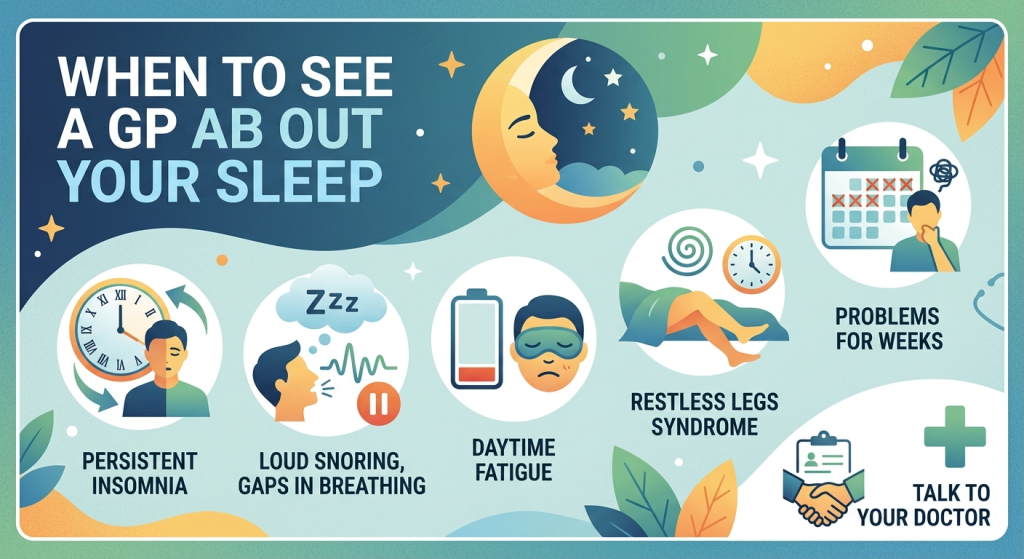
Knowing exactly when to see a GP can be difficult. As a general rule, you should make an appointment with your doctor if :
Your sleep problems have persisted for more than a month and are not improving despite good sleep hygiene.
Your inability to sleep is affecting your daily life, making it hard to concentrate, work, or care for your family.
You suspect you have sleep apnoea (your partner notices you snore loudly, gasp, or stop breathing in your sleep).
You experience unusual behaviours during sleep, such as sleepwalking or sudden physical movements.
You are relying on alcohol or over-the-counter medications to get to sleep.
When you see your GP, it is incredibly helpful to keep a “sleep diary” for a couple of weeks prior. Note down what time you went to bed, how long it took to fall asleep, how many times you woke up, what you ate or drank in the evening, and how you felt the next day. This provides your doctor with invaluable data to make an accurate diagnosis.
Frequently Asked Questions (FAQ)
1. Can you “catch up” on missed sleep at the weekend?
While you might feel less tired after a long lie-in, you cannot truly “catch up” on sleep. Sleeping in on weekends disrupts your circadian rhythm, making it harder to fall asleep on Sunday night and creating a cycle known as “social jetlag.” It is far better to maintain a consistent wake-up time every day.
2. Is it bad to eat right before bed?
Eating a heavy meal right before bed can cause indigestion and acid reflux, which disrupt sleep. However, going to bed hungry can also keep you awake. If you need a late-night snack, opt for something small and easily digestible, like a banana or a small bowl of oatmeal.
3. What is sleep paralysis?
Sleep paralysis is a temporary inability to move or speak when waking up or falling asleep. It occurs when the brain wakes up from REM sleep before the body’s natural muscle atonia (paralysis) wears off. While it can be terrifying, it is generally harmless and not a sign of a serious medical condition, though severe or frequent episodes should be discussed with a GP.
4. Will magnesium supplements help me sleep?
While magnesium plays a role in muscle relaxation and nervous system regulation, there is currently insufficient high-quality peer-reviewed evidence to recommend magnesium supplements as a primary treatment for clinical insomnia. You should always consult your GP before starting any new supplements.
References
1. NHS. (2022). *Insomnia – Causes*. Available at:
https://www.nhs.uk/conditions/insomnia/causes/ (Accessed: October 2023).
2. American Academy of Sleep Medicine (AASM). (2014). International Classification of Sleep Disorders (3rd ed.). Darien, IL: American Academy of Sleep Medicine.
3. Roehrs, T., & Roth, T. (2001). Sleep, sleepiness, and alcohol use. Alcohol Research & Health, 25(2), 101-109.
4. St-Onge, M. P., Grandner, M. A., Brown, D., et al. (2016). Sleep Duration and Quality: Impact on Lifestyle Behaviors and Cardiometabolic Health. Circulation, 134(18), e367-e386.
5. Irish, L. A., Kline, C. E., Gunn, H. E., Buysse, D. J., & Hall, M. H. (2008). The role of sleep hygiene in promoting public health: A review of empirical evidence. Sleep Medicine Reviews, 12(1), 1-13.
6. Morin, C. M., Culbert, J. P., & Schwartz, S. M. (1994). Nonpharmacological interventions for insomnia: a meta-analysis of treatment efficacy. American Journal of Psychiatry, 151(8), 1172-1180.
7. National Institute for Health and Care Excellence (NICE). (2021). Insomnia: *NICE Pathways*.
Available at: https://pathways.nice.org.uk/pathways/insomnia (Accessed: October 2023).
8. NICE. (2004). Guidance on the use of zaleplon, zolpidem and zopiclone for the short-term management of insomnia (Technology Appraisal Guidance TA77).
9. NHS. (2022). *Insomnia – Treatment*. Available at: https://www.nhs.uk/conditions/insomnia/treatment/ (Accessed: October 2023).